
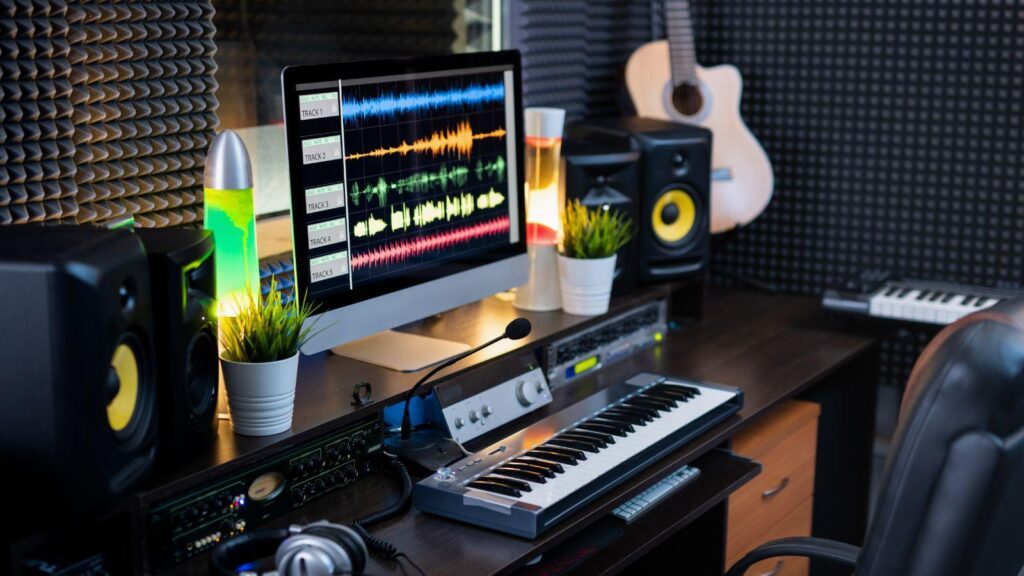
A decent audio interface costs the same whether you’re in Bristol or Brisbane. The invoice doesn’t care about the exchange rate. But a Brisbane producer ordering a Focusrite Scarlett 4i4 from a US retailer in mid-2026 is effectively paying a 20, 25% currency surcharge before freight and import duties even enter the picture. That gap is real, and it’s wide enough to kill a studio build before it starts.
This is the financial reality shaping how independent Australian producers approach gear acquisition. And it’s pushing a generation of bedroom beatmakers toward income streams that didn’t exist a decade ago. Creative Australia’s 2025 economic report put the local music industry at $8.78 billion, but very little of that flows back to the producer sitting on a second-hand chair in a treated spare room in Fitzroy or Fortitude Valley. They’re funding studio builds the way freelancers always have: by stitching together income from wherever they can reach it.
Some of those income streams are predictable. Sync licensing, session work, teaching Ableton over Zoom. Others are less obvious. East Bay Express has mapped the low-deposit entertainment platforms that Australian producers are quietly using between sessions to stretch their discretionary income further, and the options listed there reflect a broader pattern: low barrier to entry, fast mobile access, no need to leave the studio chair.
The Gear Cost Problem Is Structural, Not Personal
This isn’t about individual producers making bad financial decisions. The structure is the problem.
A Shure SM7B retails for around AUD $449 through Australian authorised dealers. The same mic through a US retailer is closer to AUD $280 landed, if you’re willing to navigate the warranty grey zone. Most producers know this math by the time they’re shopping for their second piece of gear. The result is a constant mental calculation: wait for a local deal, import directly, or put the build on hold while the savings account catches up.
According to reporting from The Music, two-thirds of Australian and New Zealand artists operate with release budgets of $500 or less. That’s not a release budget that leaves room for acoustic treatment panels, a proper monitoring setup, and a half-decent preamp in the same financial year. Something always gets deferred.
The producers who build faster are the ones who treat studio funding as a portfolio problem, not a savings problem.
What the Side Hustle Stack Actually Looks Like
Talk to working producers in Sydney or Melbourne and the income picture that emerges is rarely clean. It’s layered.
Sync licensing is the dream, but it pays unpredictably. A track placed in a streaming ad campaign might clear $300. The same track sitting in a library for six months might clear nothing. Session guitar work for other artists brings in more predictable income, typically $150, $250 per remote session, but it eats the hours that would otherwise go toward original work. Teaching pays steadily. Online platforms like Lessonface and TakeLessons have opened up international students for Aussie producers with niche skills. But it’s time-heavy in a way that sync and session work isn’t.
And then there are the platforms producers use purely on downtime. Not as a primary income strategy. More as a way to make the dead hours between sessions feel slightly less dead, with the occasional upside. This is where the music technology careers framing breaks down a little. Most of what’s happening here is informal, habitual, and not attached to any long-term plan.
Online entertainment platforms, specifically the low-deposit casino platforms reviewed by outlets covering the Australian market, appeal to the same producer psychology that makes gear hunting addictive: finite risk, fast feedback, potential upside. A $5 deposit buys a session. You’re not committing to anything you can’t afford to lose in a coffee run.
I’m not suggesting this is a funding strategy. It isn’t. But it’s part of the texture of how independent producers manage the psychological and financial grind of building a studio incrementally, and pretending otherwise would be dishonest.
Bandcamp, Patreon, and the Platforms That Actually Move Money
Beyond the entertainment question, there’s a more substantive story about Australian producers using online platforms to directly fund gear purchases.
Bandcamp remains the most direct pipeline between a finished track and cash in hand. A producer selling a sample pack for $15 keeps roughly $12 after Bandcamp’s cut. Sell 200 packs and you’ve funded a new plugin subscription for three years, or put a serious dent in a microphone upgrade. The math works if the product is good and the audience is already built.
Patreon has been slower to gain traction in the production community than it has among YouTube educators, but producers who’ve built a tutorial following. Even a modest one. Report monthly Patreon income in the $400, $800 range from relatively small patron bases. That’s a monitor upgrade every quarter. Not transformational, but compounding.
The more interesting development is the emergence of producer-specific platforms. Splice’s creator marketplace, for example, lets producers license loops and samples on a per-download basis. Successful contributors on Splice have publicly reported monthly passive income in the low thousands. Enough to meaningfully shift the studio build timeline.
The Import-or-Wait Calculation
Here’s where the rubber meets the road for most Aussie producers building in 2026.
You’ve identified the gear you need. Let’s say it’s a Universal Audio Apollo Twin X. Australian RRP sits around AUD $1,299. You can find it for AUD $1,050 grey market. The US price, converted, lands closer to AUD $850. But you’re accepting US warranty terms and the risk of a customs flag on arrival.
Most producers in this position do one of three things. They wait and save, extending the timeline by three to six months. They buy the grey market option and accept the warranty trade-off. Or they accelerate income through whichever side channels are currently active. More sessions, a new sample pack drop, an online platform flush. And compress the timeline.
The producers who build fastest are rarely the ones with the highest income. They’re the ones who treat every income stream as a gear allocation problem and move money toward the studio before it gets absorbed by rent and groceries.
What the AI Wave Is Changing
It would be incomplete to write about Australian studio funding in mid-2026 without acknowledging the AI disruption sitting over everything right now.
The Sonarworks survey from May 2026, which pulled responses from over 1,100 producers globally, found that 60% were already using AI tools for ideation and production assistance. For Australian indie producers, AI tools offer a genuine compression of the professional gap. A solo producer with a treated spare room and a decent interface can now produce at a level that previously required session musicians and commercial studio time.
That changes the return-on-investment case for studio gear. A better microphone matters more when your monitoring and mix chain are already solid. AI mastering tools have pushed the quality ceiling on self-produced work up significantly. Which means the bottleneck shifts to tracking quality, which means acoustic treatment and mic quality matter more, not less. The gear investment case is actually stronger in 2026 than it was five years ago, which makes the funding question more pressing, not less.
For producers exploring music technology as a professional path, understanding the financial structures that support independent creative work is as important as the technical skills themselves. The music technology internship landscape in Australia has started to reflect this shift, with more placements at indie labels and production houses than at traditional commercial studios.
FAQ
How much does it realistically cost to build a functional home studio in Australia in 2026? A functional recording setup. Interface, condenser mic, headphones, basic acoustic treatment, and a DAW licence. Runs roughly AUD $1,800, $2,500 sourced locally. Import-savvy producers building the same rig through US grey-market channels can land closer to AUD $1,200, $1,500, accepting warranty trade-offs on individual components.
Why do Australian producers face higher gear costs than US or UK counterparts? Three layers: currency conversion (the AUD trades at roughly 0.63, 0.65 USD in mid-2026), import duties on electronics, and the limited authorised dealer network driving up local RRP. Freight from US retailers adds another $40, $120 per shipment depending on weight.
What online platforms are Australian producers actually using to generate side income? Sample marketplaces like Splice and Bandcamp are the most common. Patreon works for producers with a tutorial or process-sharing audience. Teaching platforms including Lessonface and TakeLessons open up international student access. Some producers also use low-deposit entertainment platforms on downtime, though this is incidental rather than strategic.
Does AI production software reduce the need for hardware investment? Not really. It shifts it. AI mastering and mixing tools raise the quality ceiling on self-produced work, which moves the bottleneck upstream to tracking quality. Better microphones and acoustic treatment matter more when the rest of the chain is already strong. The hardware investment case in 2026 is arguably stronger than it was five years ago.
How long does it typically take an Australian indie producer to fully fund a home studio build? With a side hustle income of $300, $500 per month allocated purely to gear, most producers complete a functional setup in 12, 18 months. Those using a combination of sync licensing, sample pack sales, and session income can compress that to 6, 9 months if they’re disciplined about allocation.
The Honest Picture
There’s no clean funding path for an independent Australian producer building a studio from scratch in 2026. The gear costs are structural, the streaming returns are thin, and the currency gap isn’t closing anytime soon.
What is changing is the range of income streams available and the quality ceiling that a modest studio setup can reach. Producers who treat studio funding as a portfolio problem. Stacking sync income, sample sales, teaching, and platform income without relying on any single channel. Are building faster than producers waiting for a single break to change everything.
The goal is always the same: get the room sounding good enough that the gear stops being the limiting factor. Everything else is just financing the path to that point.
Gambling involves risk. Please play responsibly and only wager what you can afford to lose. If you feel gambling is becoming a problem, visit BeGambleAware.org or call 1-800-GAMBLER.